
EUDR and Timber: A Practical Guide for the Forestry Sector

By Bruno Domínguez García · CEO and co-founder of Coolx
Published on March 23, 2026 · Updated on August 18, 2026
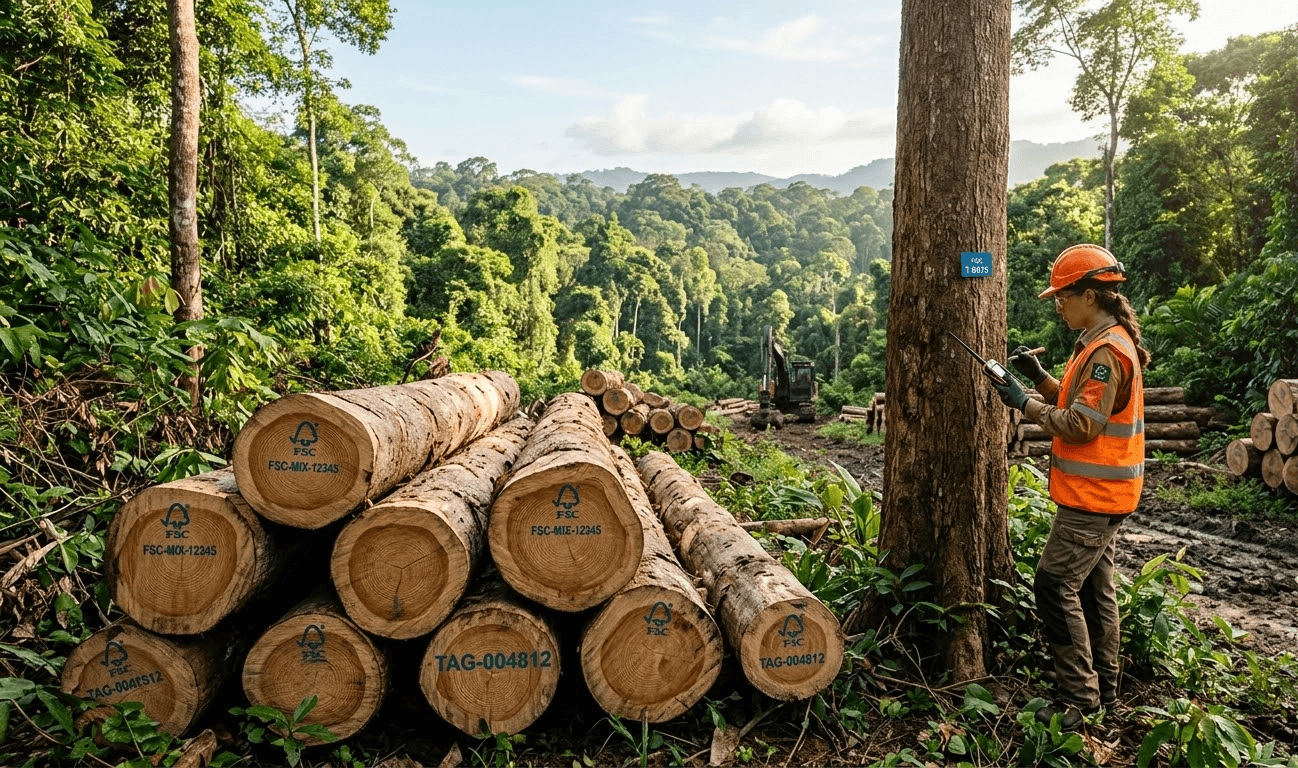
The European timber industry has operated under regulatory scrutiny for over a decade. Since 2013, the EU Timber Regulation (EUTR) has required operators to verify the legality of wood entering the European market. But from 30 December 2026, the EUTR gives way to the EU Deforestation Regulation (EUDR), and the rules change fundamentally. Proving legality is no longer enough: companies must now demonstrate that their timber does not originate from land deforested after 31 December 2020, backed by verifiable geolocation data for every plot of origin. For timber importers, furniture manufacturers, paper producers, and packaging companies, understanding these changes and preparing in time is a business-critical priority. Non-compliance penalty caps start at 4% of annual EU turnover.
From EUTR to EUDR: What Changes for the Timber Sector
The EUTR and EUDR share a common goal — combating forest destruction linked to European trade — but the EUDR raises the bar dramatically. Here are the key differences:
Scope: From Legality to Deforestation
The EUTR focused on preventing illegally logged timber from reaching the EU market. If an operator could prove legal sourcing, they were compliant. The EUDR goes further: beyond legality, it requires proof that timber does not come from areas where deforestation or forest degradation occurred after 31 December 2020. This means legally harvested timber from recently deforested land cannot enter the European market.
Traceability: From Basic Records to Mandatory Geolocation
The EUTR required supplier and customer records but did not demand tracing products back to the specific plot of origin. The EUDR makes this explicit:
- Forest plots smaller than 4 hectares: a GPS point (latitude and longitude).
- Plots larger than 4 hectares: a georeferenced polygon describing the full perimeter of the harvesting area.
For a sector where supply chains can involve dozens of intermediaries between forest and European factory, this requirement transforms traceability from an administrative function into core operating infrastructure.
Verification: From Document-Based Due Diligence to Satellite Analysis
Under the EUTR, due diligence was primarily document-based: logging permits, certificates of origin, invoices. The EUDR maintains documentary obligations but adds satellite imagery verification. Operators must cross-check declared geolocations against forest cover data to confirm that no deforestation has occurred at those coordinates since 2020.
Formal Declaration: From Self-Assessment to TRACES
The EUTR did not require a formal declaration through any centralised system. The EUDR introduces the obligation to submit a Due Diligence Statement (DDS) through TRACES NT, the European Commission's system. Without an approved declaration, the product cannot enter the EU market.
Transition Period
The EUTR will remain in force on a transitional basis until 31 December 2029 for certain operations. However, for all new market placements from 30 December 2026, EUDR rules apply. Companies that operated comfortably under the EUTR must assume that their current systems are likely insufficient.
Which Timber Products Does EUDR Cover?
The EUDR significantly broadens the scope compared to the EUTR. Covered wood products include:
- Raw timber: logs, roundwood, firewood
- Sawn and processed wood: planks, beams, particleboard, plywood, MDF
- Pulp and paper: wood pulp, paper and cardboard, printing paper
- Wooden furniture: chairs, tables, shelves, cabinets — any furniture with wood components
- Charcoal
- Finished wood products: frames, tools with wooden handles, manufactured wood articles
What Is NOT Covered (Key Exclusions)
The December 2025 reform introduced important exclusions for the sector:
- Books, newspapers, and printed publications (Chapter 49 of the tariff code) fall outside the scope. Publishers and printing companies have no EUDR obligations.
- Packaging used to support, protect, or carry another product is excluded, whether wood or cardboard. A pallet carrying machinery or a cardboard box containing food are not in scope.
- Bamboo and rattan products are not classified as wood under the regulation.
- Second-hand goods, waste, and recycled material are excluded.
- Product samples of negligible value are also out of scope.
This distinction is critical for paper and packaging companies, which must verify whether their specific products fall within or outside the scope based on their Combined Nomenclature (CN) code.
Forest Plot Geolocation: The Central Challenge
If geolocating coffee farms is already a logistical challenge, the timber sector faces additional complications due to the nature of the product:
Large-Scale Forest Concessions
Unlike agricultural farms, forestry operations often span hundreds or thousands of hectares. Tracing precise polygons of specific harvesting areas within vast concessions requires advanced mapping systems and continuous updates, as harvesting zones rotate over time according to forest management plans.
Multiple Origins in a Single Shipment
A consignment of sawn timber may contain logs from dozens of different plots, processed and mixed at a sawmill. Linking each piece of wood to its plot of origin demands granular traceability that few operators currently have in place.
Remote and Hard-to-Access Areas
Many forest operations, particularly in tropical countries across Latin America, Central Africa, and Southeast Asia, are located in areas with limited connectivity, no digital mapping infrastructure, and in some cases unresolved land tenure conflicts.
Forestry Data vs Agricultural Data
While agricultural plots tend to have stable boundaries year after year, harvesting zones in forestry shift according to management plans. The EUDR requires linking each lot to the exact harvesting area, not simply to the general concession.
Why FSC and PEFC Are Not Enough for EUDR Compliance
This is one of the most widespread misconceptions in the timber industry. Many companies assume that FSC or PEFC certification means EUDR compliance. It does not.
The EUDR does not recognise any certification scheme as a substitute for due diligence. Neither FSC, nor PEFC, nor any other scheme provides a "fast track" to compliance. The reasons are straightforward:
- EUDR requires data, not certificates. Compliance demands verifiable geolocations, satellite-based deforestation analysis, documented risk assessment, and a DDS submitted through TRACES. An FSC certificate attests to good forest management practices, but does not provide these specific data points.
- Liability rests with the operator, not the certifier. If a certified product is found to be linked to deforestation, legal responsibility falls on the operator who submitted the DDS, not on the certification body.
- Standards do not align exactly. The deforestation criteria used by FSC/PEFC and the EUDR are not identical. The EUDR uses the FAO definition of "forest" and the cut-off date of 31 December 2020, which may not perfectly match certification standards.
That said, certifications remain valuable as supporting tools. Both FSC and PEFC are adapting their systems to facilitate the collection of EUDR-required data: geolocations, chain of custody, legal documentation. Companies with certified timber have a head start — but they need to go beyond the certificate.
Challenges for Timber Exporters and Importers
The Scale of the Problem
The numbers put the urgency in context. According to INTERPOL and UNEP, 86% of illegal tropical timber enters the EU as paper, pulp, or wood chips — not as logs or planks. This means industries that have not traditionally seen themselves as linked to illegal logging — paper mills, packaging manufacturers, MDF producers — fall directly within the regulation's scope.
The EU is the world's second-largest importer of products linked to tropical deforestation, accounting for 16% of trade-linked deforestation globally. Only China imports more. Approximately 45% of all timber exported from the Amazon Basin reaches Europe, with Brazil as the primary supplier.
Challenges for Exporters
- Supply chain digitisation. Moving from manual records to digital traceability systems takes 3 to 9 months. And the lag between harvesting and arrival at EU customs can exceed 6 months. Companies need compliant material flowing through their systems now if they want uninterrupted market access in 2027.
- Local legislation compliance. Beyond deforestation, the EUDR requires products to comply with the producing country's legislation: land-use rights, environmental regulations, labour rights, and tax rules. In many timber-producing countries, compiling and verifying this documentation is a lengthy and complex process.
- Market exclusion risk. Studies project significant reductions in timber exports from countries with high deforestation rates. Brazil could see 7–10% price decreases for roundwood. The real risk is that non-compliant timber finds buyers outside the EU, displacing the problem rather than solving it.
Challenges for European Importers
- Geolocation verification at scale. Checking that polygons and coordinates provided by each supplier are accurate, complete, and verifiable against satellite imagery.
- Managing suppliers in risk-rated countries. The EU's benchmarking system currently classifies 4 countries as high risk (Belarus, Myanmar, North Korea, Russia) with 9% inspection rates. Standard-risk countries face 3% inspections, and low-risk countries 1%.
- Adapting internal systems. Management systems that worked under the EUTR — based on documents and retrospective audits — are not sufficient for the EUDR, which demands continuous traceability, satellite verification, and DDS submission through TRACES.
Key Takeaways
- EUDR replaces the EUTR from 30 December 2026, with a transitional period extending to 2029 for certain EUTR-covered products.
- The fundamental shift: proving legality is no longer enough — companies must demonstrate absence of deforestation after 2020, with verifiable geolocations.
- Covered products include raw timber, sawn wood, pulp, paper, furniture, and charcoal. Books, support packaging, bamboo, and recycled products are excluded.
- FSC and PEFC certifications do not replace EUDR due diligence. They are a useful support, but not a compliance shortcut.
- 86% of illegal tropical timber enters the EU as paper or pulp, not as logs — the paper sector is directly in scope.
- Forest plot geolocation presents sector-specific challenges: large concessions, rotating harvesting zones, and multiple origins per shipment.
- Non-compliance penalty caps start at 4% of annual EU turnover, plus product confiscation and exclusion from public procurement.
How to Prepare Now
Nine months remain before enforcement begins. Timber companies that already operated under the EUTR have a foundation, but need to expand it significantly: from legality records to geolocation systems, from document audits to satellite verification, from internal self-assessments to formal declarations through TRACES.
Supply chain digitisation is not a project that resolves itself in weeks. Every link — from forest concession to European warehouse — must generate verifiable, interconnected, and auditable data. Companies that start now will reach 30 December with margin. Those waiting for the April simplification review risk running out of time.
Platforms like Coolx enable centralised management of forestry suppliers, automated deforestation analysis using Copernicus satellite imagery, legal documentation management for each origin, and DDS generation ready for TRACES submission. If timber is part of your supply chain and you need a comprehensive EUDR compliance solution, visit coolx.earth or get in touch with the team.
Need help with your EUDR compliance?
Talk to an expert and find out how Coolx can help you comply before December 2026.
Talk to an EUDR expert