
How the EUDR stands for companies selling to Europe — May 2026

By Emilio Muela Pérez · COO/CFO and co-founder of Coolx
Published on May 18, 2026
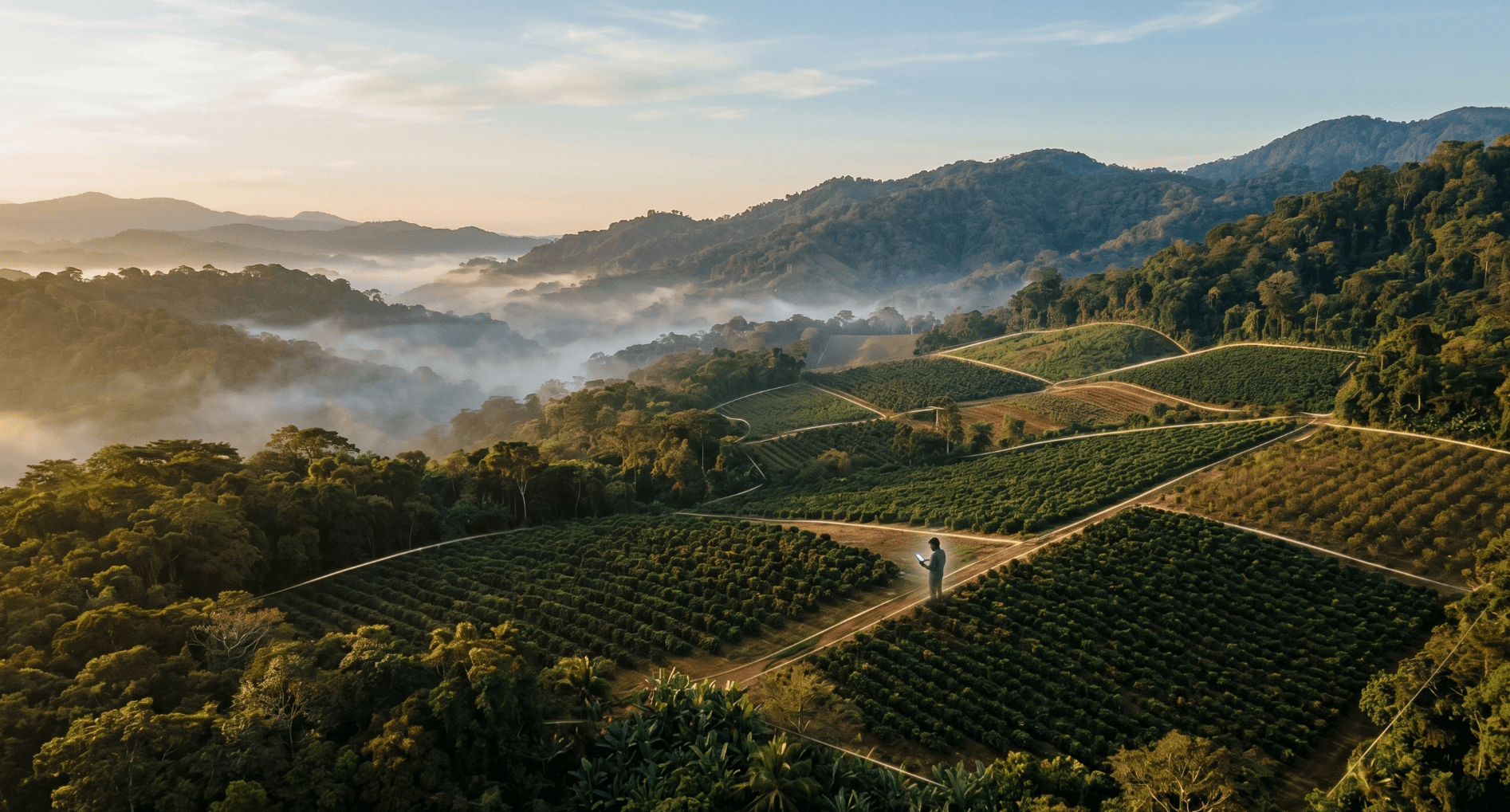
If you export coffee, cocoa, soy, palm oil, rubber, cattle or timber to the European market, EUDR is already shaping what your client is asking from you. The package the European Commission released on 4 May 2026 (Report COM(2026), Guidance C(2026), FAQs Version 5, Revised Implementing Regulation on the Information System) has closed the operational doubts that were still open. Commissioner Roswall made the political position equally clear that day: 30 December 2026 is final.
There are 226 days left.
The EUDR imposes no direct legal obligations on exporters to Europe (unless they place product on the EU under Art. 7). But that reading is deceptive: the European importer can neither exercise due diligence nor file the Due Diligence Statement without the information that originates with the producer.
Whoever is not ready loses the client. Whoever moves first captures market share. This article explains what your EU buyers will ask, what changes by your country's risk classification, and the 7 actionable steps to respond to the demand before the European buyer finds an alternative.
Why EUDR reaches you even though it does not directly bind you
The Regulation applies to the first operator placing the product on the EU market. If your company sells to a European importer, that importer is the obligee. But the system works as follows:
- Without plot geolocation for the raw material, the importer cannot submit a valid Due Diligence Statement.
- Without local legal evidence (land titles, harvest licences, environmental permits, labour records), the importer cannot demonstrate compliance with Art. 2(40) EUDR.
- Without documented lot traceability, the product cannot be linked to a specific plot and the Due Diligence Statement does not hold.
- Without physical and documentary segregation from untraced product, the importer assumes mixing risk and would rather not buy.
The commercial consequence is direct: if you do not provide the data, your European client switches supplier. And the better-prepared suppliers are already negotiating price premiums.
What changed after the 4 May package
The set of documents released that day stabilised the operational framework. The key pieces:
- Official Guidance C(2026) 3056 final — updates the Commission's interpretation on operator obligations and required formats.
- FAQs V5 (April 2026) — includes 750+ questions analysed and specific clarifications on non-EU supply chains.
- Report COM(2026) final — confirms there will be no further amendments to the legal text.
- Country benchmarking in force — Implementing Regulation (EU) 2025/1093, in force since May 2025: classifies every producing country as low, standard or high risk. The European Parliament adopted on 9 July 2025 a resolution of objection challenging methodology and data, but it is non-binding and the Regulation remains fully applicable. The Commission has committed to a review during 2026 with updated FAO data.
- Revised Implementing Act on the Information System — TRACES reopens in June 2026 with updated APIs.
For an exporter in Honduras, Côte d'Ivoire, Argentina or Vietnam, the answer "let's wait and see what Brussels says" no longer holds. From the European side, everything has been said.
What European buyers are asking from you
The list any EU importer is already requesting from non-EU suppliers in May 2026:
- Plot geolocation — GeoJSON format, latitude/longitude with six decimals, WGS84 (EPSG:4326). For plot commodities (coffee, cocoa, soy, palm, rubber, timber): perimeter polygon mandatory for plots >4 ha; GPS point or polygon for ≤4 ha. For cattle: one point per establishment, regardless of size.
- Documentary evidence of local legality — land titles or equivalents, harvest or exploitation licences, environmental permits where applicable, labour records compliant with national legislation.
- Lot-to-plot traceability — verifiable system linking each shipment to source plots.
- Proof of no post-31/12/2020 deforestation — satellite imagery or historical forest record proving the plot was no longer converted forest after that date.
- Physical and documentary segregation — mixing with untraced product is not allowed. Without verifiable segregation, the entire lot becomes contaminated.
- Cooperation in audits — providing buyer or third-party verifier access to plots and records if needed.
- Delivering the data package before shipment, not after, so the importer has the time needed to exercise due diligence and file the Statement.
How your situation changes by country classification
Reg. (EU) 2025/1093 established the country benchmarking in three tiers. The Regulation remains in force (the European Parliament objection of 9 July 2025 was a non-binding resolution and the Commission did not withdraw it), although a revision is due during 2026 with updated FAO data. Until then, the operational consequence for an exporter is very different depending on placement.
If your country is low risk:
- Geolocation still required. The MSPO regime allows postal address or cadastral reference instead of coordinates, but only if the micro/small producer is the one placing the product on the EU market or exporting it directly — a minority case in chains with intermediaries. If you sell to a European importer, the MSPO flexibility does not apply and full geolocation is required.
- Your EU buyer applies the simplified procedure of Art. 13 — no need for risk assessment or mitigation unless substantiated concern emerges.
- Commercial positioning: natural advantage. Worth monetising fast before national competitors do.
If your country is standard or high risk:
- Mandatory geolocation with no format exceptions.
- Your EU buyer applies full due diligence: risk assessment Art. 10 + mitigation Art. 11.
- Official inspection rates: 3% in standard, 9% in high risk (on operators and volume). Brussels focuses enforcement here: 95% of global deforestation is concentrated in these categories.
- Positioning: differentiation by data quality. Whoever delivers an impeccable package becomes the preferred supplier ahead of the rest of the country.
Producing countries that have already deployed digital infrastructure aligned with EUDR:
- Ethiopia and Honduras in coffee
- Ghana in cocoa
- Argentina (VISEC)
- Brazil (Selo Verde) in soy
- Thailand
- Côte d'Ivoire
- Malaysia
- Indonesia
- Kenya
The concrete commercial risk if you do not act
It is not a regulatory risk on you directly. It is a market risk:
- Substitution by better-prepared suppliers. In coffee, cocoa and soy there are already producing countries with national digital systems delivering the data package via API integration.
- Pricing pressure. Untraced lot = undifferentiated lot = commodity benchmark at worst price. Lot with full EUDR package = potential premium.
- Blocked access to the EU market. If your importer cannot close the Due Diligence Statement due to missing data from you, they do not buy. The cargo does not enter. And the commercial relationship breaks.
- Account loss to faster non-EU competitors. Your competitors are not only those in your country; they are anyone in any other producing country offering the same commodity with better data packaging.
Seven actionable steps for non-EU exporters
- Identify your country's risk classification in Reg. (EU) 2025/1093. That single data point defines the documentary stringency the EU buyer will apply.
- Map every sourcing plot or establishment with GeoJSON. If working with cooperatives or smallholder associations, register each associated producer with its individual polygon.
- Audit the productive use start date of each plot. If conversion to agricultural use post-dates 31 December 2020, the plot is out of the EU market. Document the forest status at that date with satellite imagery or official record.
- Collect and digitise local legal documentation. Titles, licences, permits, labour records. Centralise in an accessible dossier shareable with the European buyer in structured format.
- Implement a physical and documentary segregation system. Lot tagging, weighbridge records, anti-contamination control between traced and untraced stock. If the system is not verifiable, the importer assumes the worst case.
- Send the package proactively to the buyer, before being asked. The difference between "the supplier we have to chase data from" and "the supplier who delivers it sorted". This makes you the preferred supplier.
- Consider direct registration in TRACES via Art. 7. If you place product on the EU through a European subsidiary or as a non-EU legal entity with an EORI number, you become an operator and submit your own Due Diligence Statement — you control the flow and reduce dependence on the importer.
Myths you can drop
- "Non-EU exporters are not obliged." — Important caveat: legally no, commercially yes. The EU market will not buy without your data.
- "Another extension is coming." — The Commission has closed the debate. No third amendment on the horizon.
- "TRACES will not be operational." — Reopens June 2026 with APIs and outage contingency plan.
- "Geolocation means expensive professional GPS." — Modern phones with GNSS receivers and free GIS apps are enough to reach 6-decimal WGS84. No mobile coverage required, only satellite signal.
- "If my country is low-risk, no geolocation is required." — It is. The MSPO flexibility only applies to micro/small primary producers who themselves place the product on the EU market; if you sell to a European importer, that importer needs full geolocation.
Key takeaways
- EUDR does not bind you legally, but it determines whether your European importer can buy from you.
- Your country classification (Reg. 2025/1093) defines the stringency level: low risk = simplified procedure; standard/high = full due diligence.
- Without GeoJSON geolocation, local legal documentation and lot-to-plot traceability, there is no Due Diligence Statement and no sale.
- 226 days to 30 December 2026. Extensions are over.
- Producing countries that invested early (Ethiopia, Honduras, Ghana, Argentina, Brazil, Thailand, Côte d'Ivoire) are capturing contracts.
- Anticipating the data package to the buyer = contractual advantage and potential price premiums.
How to prepare before December 2026
Capturing polygons for tens or hundreds of farms takes two to three months of field work if no system is in place. Centralising legal documentation across dispersed cooperatives takes weeks of coordination. Negotiating with European buyers about the exact format they expect is a conversation that cannot be left for December. Producers entering Q4 2026 without a productive system will face buyers who will have already closed annual contracts with better-prepared suppliers.
Coolx supports associations, cooperatives and non-EU exporters with plot registration, geolocation generation, satellite deforestation analysis, automated legal documentation analysis and direct communication with European buyers — all in a single platform integrated with the importer's Due Diligence Statement. To see how it fits your operation ahead of the deadline, visit coolx.earth or contact our team.
Need help with your EUDR compliance?
Talk to an expert and find out how Coolx can help you comply before December 2026.
Talk to an EUDR expert