
EUDR Annex I Update: Delegated Regulation (EU) 2026/2102

By Bruno Domínguez García · CEO and co-founder of Coolx
Published on September 22, 2026
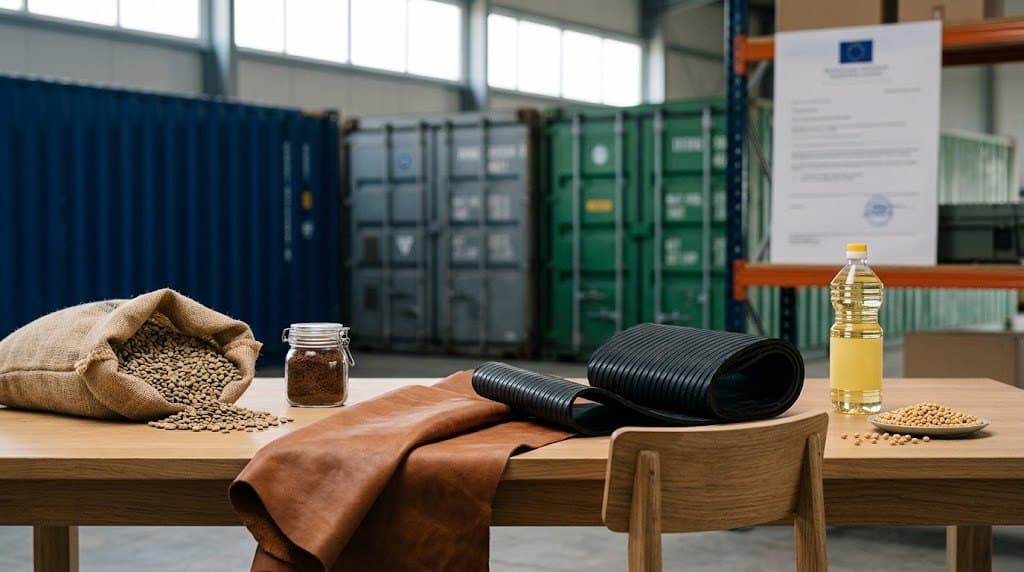
On 17 September 2026 the Official Journal of the European Union published Commission Delegated Regulation (EU) 2026/2102, amending Annex I to Regulation (EU) 2023/1115, the EU Deforestation Regulation (EUDR). It entered into force on 18 September 2026 and applies directly in every Member State, with no national transposition.
Annex I is the list that decides which products need a due diligence statement. That makes this amendment relevant to any company importing, trading or exporting coffee, cocoa, soy, palm oil, rubber, wood or cattle products: some products leave the scope, some come in, and a set of clarifications settles questions that had been open since 2023.
📊 The essentials in three facts
- In force since 18 September 2026: exclusions, clarifications and the reworded entries (ex 0102, 1201 90 00, the seats list) already apply.
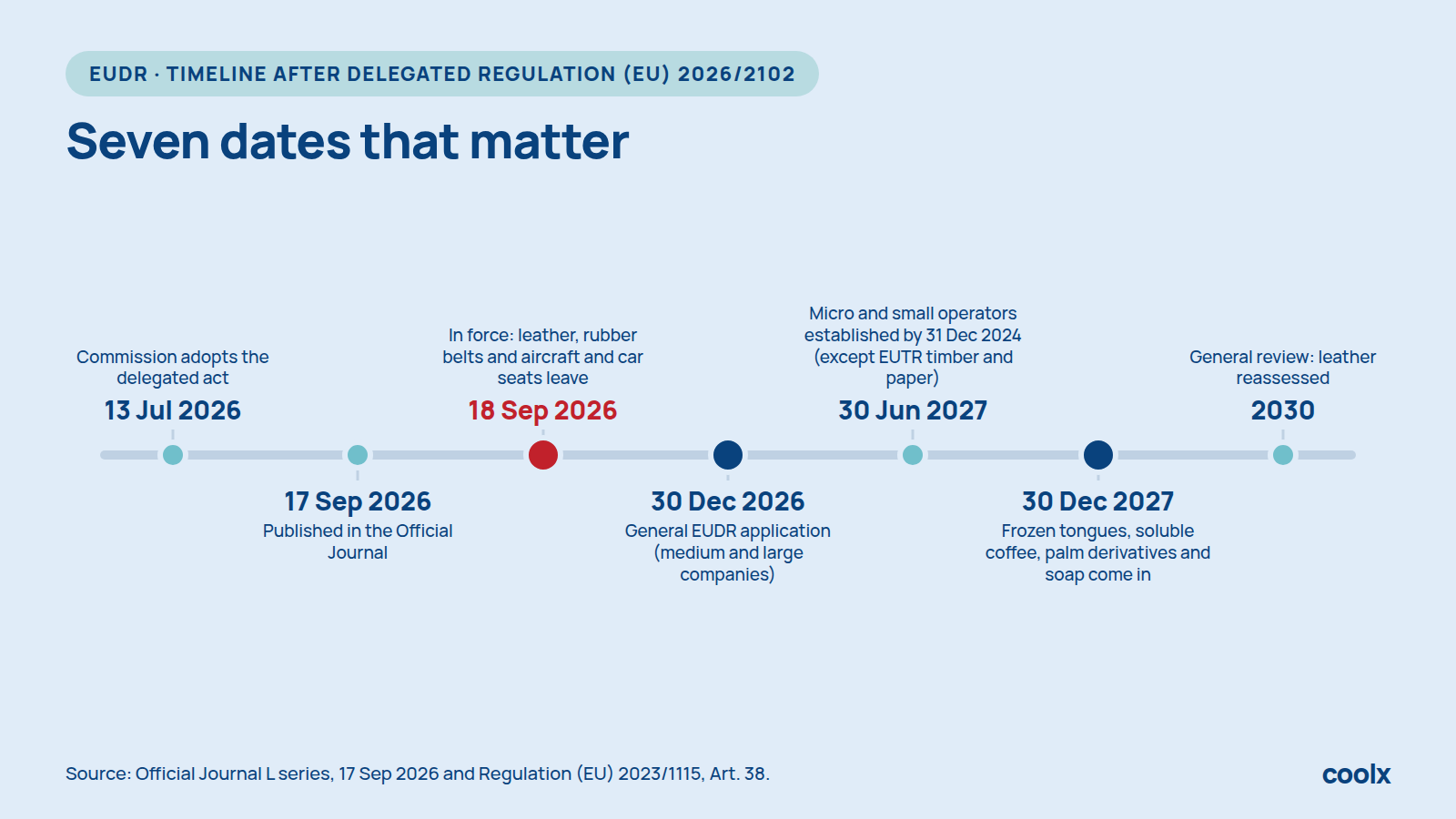
- Products added (frozen cattle tongues, soluble coffee, palm oil derivatives and soap) only become subject to the EUDR from 30 December 2027.
- The general EUDR date does not move: 30 December 2026 for medium-sized and large companies.
What Delegated Regulation (EU) 2026/2102 is and why it matters
The Commission adopted the text on 13 July 2026 under Article 34(1) of the EUDR, which allows it to amend the CN codes in Annex I without reopening the base regulation. The European Parliament and the Council had two months to object. Neither did, and the act went to the Official Journal.
It is the first time the Commission revises Annex I by delegated act; the 2025 reform had already removed printed products of Chapter 49 from the list. It follows two public consultations (April to May 2025, and 4 May to 1 June 2026, the latter with 4,785 contributions) and the assessment of 25 product codes proposed by industry, of which the Commission accepted six changes.
The seven commodities stay the same. What changes is the list of derived products and, above all, how precisely each entry is defined.
📅 Two dates, not one
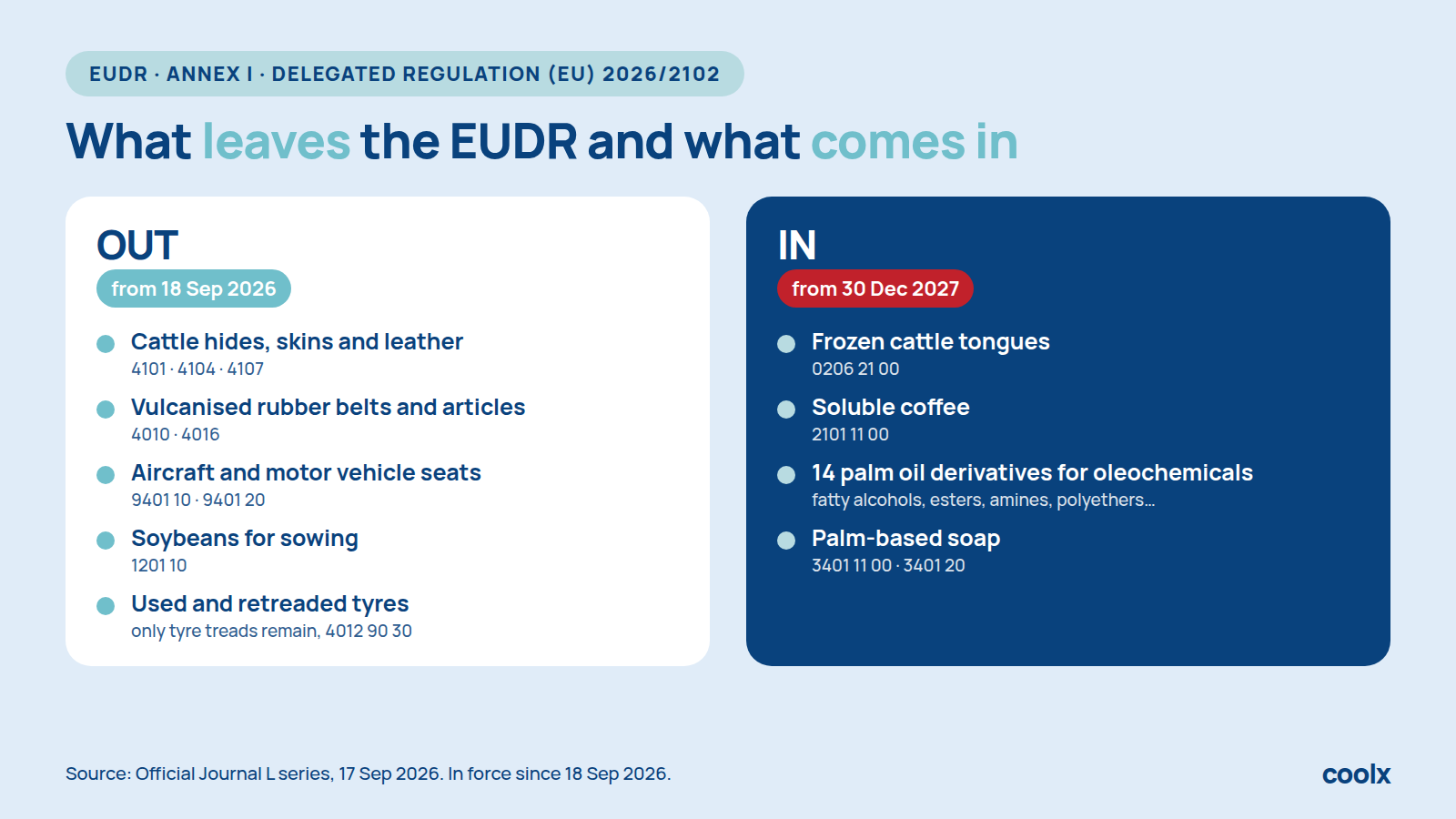
Everything that leaves Annex I or is clarified applies from 18 September 2026. Everything that comes in carries the wording "this provision shall apply from 30 December 2027", to give companies, customs and competent authorities time to adapt. Until then, those products can still be placed on the market without a due diligence statement.
Products added to EUDR Annex I
Every addition follows the same logic: stop a derived product from entering the EU market without the obligations that already apply to its raw material. The Commission calls this "relocation of the deforestation risk". Coffee beans were in scope and soluble coffee was not; fresh cattle tongues were in scope and frozen ones were not.
| Product | CN code | Commodity | Applies from |
|---|---|---|---|
| Frozen cattle tongues | ex 0206 21 00 | Cattle | 30 Dec 2027 |
| Extracts, essences and concentrates of coffee (soluble coffee) | 2101 11 00 | Coffee | 30 Dec 2027 |
| Hydrogenated, inter-esterified or re-esterified palm oils | ex 1516 20 | Oil palm | 30 Dec 2027 |
| Chemically modified palm oils and inedible mixtures containing palm | ex 1518 00 | Oil palm | 30 Dec 2027 |
| Crude glycerol, glycerol waters and lyes from palm | ex 1520 00 | Oil palm | 30 Dec 2027 |
| Fatty alcohols synthesised from palm (octanol, lauryl, cetyl, stearyl and others) | ex 2905 16 · ex 2905 17 00 · ex 2905 19 00 | Oil palm | 30 Dec 2027 |
| Esters of acetic acid; oleic, linoleic and linolenic acids; undecenoic acids | ex 2915 39 · ex 2916 15 · ex 2916 19 10 | Oil palm | 30 Dec 2027 |
| Acyclic monoamines, quaternary ammonium salts and acyclic amides from palm | ex 2921 19 · ex 2923 90 00 · ex 2924 19 00 | Oil palm | 30 Dec 2027 |
| Toilet soap and soap in other forms containing palm | ex 3401 11 00 · ex 3401 20 | Oil palm | 30 Dec 2027 |
| Other chemical products and polyethers made using palm | ex 3824 99 · ex 3907 29 | Oil palm | 30 Dec 2027 |
The largest block is oleochemicals: fatty alcohols, esters, amines and polyethers used in paints, lubricants, cosmetics, detergents and food additives. Annex I did not cover the full chain of palm oil derivatives, and the Commission saw that as a gap.
Every palm code carries the "ex" marker: it is in scope only to the extent the product was made using oil palm. A fatty alcohol derived from coconut or from petrochemical feedstock stays out even if it shares the tariff code.
Products removed from EUDR scope
Exclusions apply now, from 18 September 2026, with no transition period. Importers of these products no longer need a due diligence statement for them.
| Product | CN code | What changes | Commission's reasoning |
|---|---|---|---|
| Cattle hides, skins and leather: raw, tanned or crust, and further prepared | ex 4101 · ex 4104 · ex 4107 | Deleted | The leather chain separates early from the meat chain; EU operators have limited leverage to obtain the required information from suppliers |
| Conveyor and transmission belts of vulcanised rubber | ex 4010 | Deleted | Low natural rubber content |
| Other articles of vulcanised rubber | ex 4016 | Deleted | Low natural rubber content |
| Retreaded and used tyres | ex 4012 → ex 4012 90 30 | Only new tyre treads remain | Retreading extends tyre life and supports circular practices |
| Soybeans for sowing | 1201 → 1201 90 00 | Seed (1201 10) leaves | Negligible volumes and a separate chain with its own certification |
| Aircraft and motor vehicle seats | ex 9401 → closed list | Only 9401 31 00, 41 00, 61 00, 69 00, 80 00 and 91 90 remain; 9401 10 00 and 9401 20 00 leave | Very limited wood content |
The leather exclusion is the most discussed change and deserves a careful read. The Commission's own staff working document acknowledges that keeping leather in scope had significant environmental benefits against relatively low compliance costs; the removal is justified by supply chain structure and by the load on the Information System, not by lack of impact. Recital 2 puts it in writing: cattle hides, skins, leather and derived products will be reassessed in the general review in 2030.
🐄 Leather is out, the cow is not
Fresh and frozen beef (0201, 0202), edible offal (ex 0206 10) and prepared or preserved meat (ex 1602 50) remain fully in scope, with geolocation of every establishment where the animal was kept. And cattle scope widens in one place: frozen tongues from 2027. The new ex 0102 entry only simplifies the live cattle code, without changing the scope. For a slaughterhouse or a beef exporter the net result is not "less EUDR".
Some requests were rejected. Prepared and preserved meat (1602 50) and cocoa shells and waste (1802) stay in scope. Rubber balloons (9503 00 99), other soap in bars not for toilet use (3401 19 00), surfactants and detergents (3402) and wood-plastic composites do not come in. Wood waste and sawmill by-products (4401) are not removed either.
Scope clarifications: species, bamboo and rattan
Four new table notes in the commodity column close questions that competent authorities were receiving regularly.
| Commodity | What stays in | What stays out |
|---|---|---|
| Cattle | Only genus Bos and its sub-genera (Bos, Bibos, Novibos, Poephagus) | Buffalo (Syncerus), bison (Bison) and any other live bovine animal |
| Oil palm | Elaeis spp., including Elaeis guineensis | Babassu oil (Attalea spp.) and oils from other palm species |
| Rubber | Rubber of Hevea brasiliensis | Balata, gutta-percha, guayule, chicle, gums from other species and synthetic rubber |
| Wood | Annex I products made of wood | Bamboo, rattan and other materials of a woody nature: cane, reed, wicker, raffia, cereal straw and lime bark |
Many palm and rubber entries also gain the "ex" prefix. Palm derivatives that were already listed (glycerol 2905 45, palmitic and stearic acids 2915 70, other saturated monocarboxylic acids 2915 90, industrial fatty acids 3823 11, 3823 12 and 3823 19, industrial fatty alcohols 3823 70) are now covered only if synthesised using oil palm. This change applies from 18 September 2026 and narrows the scope for anyone working with other fats and oils.
Horizontal exclusions: waste, used goods, samples and packaging
The regulation adds a general note (table note 5 of Annex I) plus entry-by-entry wording that resolves everyday customs situations. The following are outside the EUDR:
- Product samples of negligible value and quantity, used only to solicit orders.
- Products for examination, analysis or testing, provided they are used up or destroyed in the test, or kept only to meet legal or contractual obligations.
- Waste within the meaning of Article 3(1) of Directive 2008/98/EC: cocoa shells, palm oils, hard rubber, wood, paper and paperboard, among others.
- Used and second-hand products, including their components: rough and sawn wood, panels, frames, furniture and seats, rubber apparel and articles.
- Packing material and packing containers, single-use or reusable, while they support, protect or carry another product. Packaging sold as a product in its own right stays in scope.
- Marketing and information material accompanying another product or supplied free of charge, and items of correspondence.
- Most palm derivatives when used in the manufacture of medicinal products for human or veterinary use covered by Directive 2001/83/EC, Regulation (EC) No 726/2004 or Regulation (EU) 2019/6. The exception is written code by code: palm oil itself and some derivatives (3823 19 and 3823 70, for example) do not carry it.
The Commission declined to extend the packaging exclusion to replacement, return, repair and service packaging, or to point-of-sale display material, on the grounds that it could open a loophole.
What it means for each sector
| Sector | Net impact |
|---|---|
| Slaughterhouses and beef exporters (Latin America → EU) | No fundamental change: meat, offal and preparations remain. Add frozen tongues to the plan for 2027. Confirm the animals are genus Bos. |
| Tanneries, footwear, leather goods, upholstery | Out of the EUDR if cattle leather was the only link. Buyers sourcing from an in-scope slaughterhouse can keep requesting traceability by contract; the 2030 review remains open. |
| Roasters and soluble coffee manufacturers | Green and roasted coffee applies from 30 Dec 2026; soluble coffee (2101 11 00) joins on 30 Dec 2027. Same origin, two calendars. |
| Oleochemicals, cosmetics, detergents and soap | New codes from 2027; existing ones count only if palm-based, and most of them drop out when destined for medicinal products. Product-by-product classification is needed. |
| Industrial rubber and tyres | Belts, belting and other vulcanised articles are out; new tyres (4011) stay in and only tyre treads remain from retreaded and used tyres (4012); synthetic rubber is out by definition. |
| Soy | Seed for sowing leaves; beans, meal, oil and derivatives are unchanged. |
| Wood, paper and furniture | Bamboo and rattan out; aircraft and car seats out; used goods, packaging, correspondence and promotional material out. |
In numbers, the Commission's report of May 2026 estimated that the scope adjustments would reduce the base of importing operators in the EU from 352,000 to 275,000. The figure combines the removal of printed products (2025 reform), leather and retreaded tyres, net of the additions; the report does not break down the weight of each.
A practical warning: the Commission's EUDR guidance (third edition, published in the Official Journal C series on 20 July 2026) predates this act and does not reflect these changes. To check whether a product is in scope, the source is the consolidated Annex I, not the guidance.
Key takeaways
- Delegated Regulation (EU) 2026/2102 was published in the Official Journal on 17 September 2026 and has been in force since 18 September 2026.
- Out of the EUDR as of now: cattle hides, skins and leather (4101, 4104, 4107), vulcanised rubber belts and articles (4010, 4016), aircraft and car seats, soybean seed and used or retreaded tyres.
- In, but only from 30 December 2027: frozen cattle tongues, soluble coffee, 14 codes of palm oil derivatives and 2 of palm-based soap.
- Cattle is limited to genus Bos, oil palm to Elaeis, rubber to Hevea brasiliensis; bamboo and rattan are outside wood.
- Samples, test products, waste, used goods, packaging, marketing material, correspondence and palm derivatives for medicinal products are excluded.
- The general timeline does not move: 30 December 2026 for medium and large companies, 30 June 2027 only for micro and small operators established by 31 December 2024, and never for the timber and paper products already covered by the EUTR, which apply from 30 December 2026 whatever the company size.
- Leather returns to the table in 2030, in the general review under Article 34.
How to prepare: what to do now
The change reads by tariff code, not by sector. These are the steps, in order:
- Review the product portfolio by CN code against the consolidated Annex I, and record for each whether it leaves, joins in 2027 or stays as is.
- Check the "ex" conditions: for palm and rubber, document the actual raw material of the product (palm or not, Hevea or synthetic).
- Apply the horizontal exclusions with care and keep the evidence: samples, testing, used goods, packaging, medicinal use.
- Plan the new products for 30 December 2027: soluble coffee and oleochemicals will need geolocation and legality evidence like any other relevant product.
- Keep traceability by contract where it makes sense, even for products that left: leather may come back in 2030.
- Update the due diligence system and the product classification in the tool that generates the statements.
Coolx keeps product classification by CN code aligned with the Annex I in force and centralises suppliers, geolocation data, satellite analysis and the creation and submission of due diligence statements, so a change like this becomes a catalogue review rather than a new project. If you want to size that project, see EUDR compliance costs and timelines, and for filing statements, the EUDR Information System guide.
If you want to know how Delegated Regulation (EU) 2026/2102 affects your products, visit coolx.earth or contact our team.
Sources
- Commission Delegated Regulation (EU) 2026/2102 of 13 July 2026 (EUR-Lex) — Official Journal L series, 17 September 2026.
- Regulation (EU) 2023/1115, consolidated text (EUR-Lex) — Annex I and Articles 34, 35 and 38.
- European Commission — Adoption of the delegated act (13 July 2026)
- European Commission — Public consultation on the draft delegated act (4 May to 1 June 2026)
- European Commission — Report COM(2026) 191 on the EUDR (May 2026) — estimate of 352,000 to 275,000 importing operators.
- European Commission — EUDR Guidance, 3rd edition, C/2026/3896 (OJ C, 20 July 2026)
Need help with your EUDR compliance?
Talk to an expert and find out how Coolx can help you comply before December 2026.
Talk to an EUDR expert