
EUDR Beyond Europe: Is the Standard Going Global?

By Bruno Domínguez García · CEO and co-founder of Coolx
Published on October 26, 2026
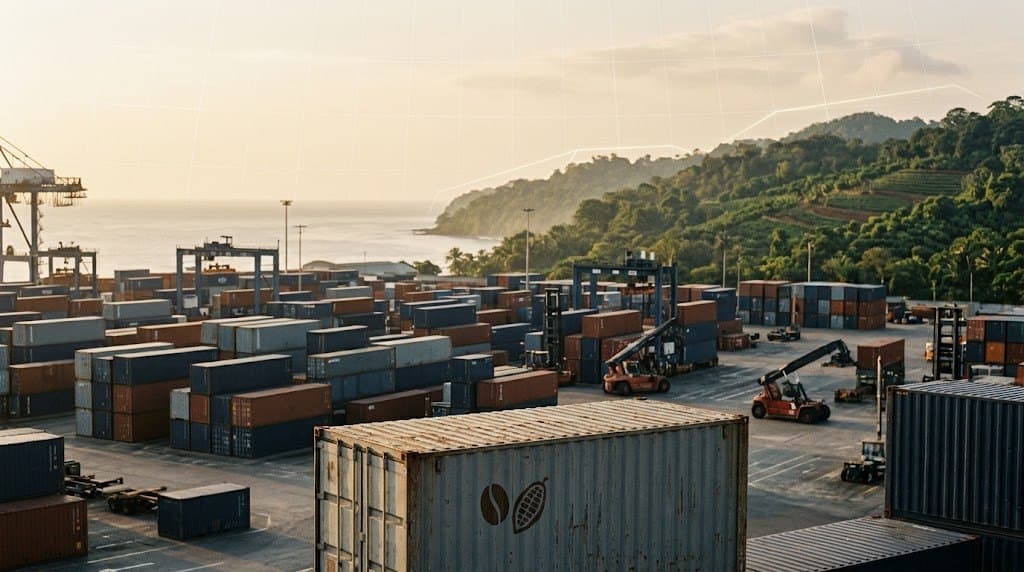
Is it worth building EUDR traceability if only part of what you grow or buy ends up in the European Union? Coffee cooperatives in Colombia, cocoa exporters in Ecuador and EU importers competing with non-EU rivals are all asking the same question.
The short answer is that the EUDR beyond Europe is not being copied as law, but it is becoming the de facto standard for entire supply chains through two channels that are already live: buyers and certifiers, and producer countries themselves. This article separates verified facts from analyst opinion. If you need the regulatory background first, start with what the EUDR is.
📊 Three figures to frame the debate
- The EU imports 40% of the world's coffee, but the companies supplying it handle 79% of global coffee trade (Trase, September 2026).
- Côte d'Ivoire requires a producer card for every cocoa transaction since 1 September 2026, not just for beans bound for Europe.
- The UK will legislate in 2027 with the same scope and geolocation as the EUDR.
EUDR beyond Europe: what sits behind the headline
The headline doing the rounds since September says the "European standard could spread to the global coffee market". It comes from a Trase analysis published on 1 September 2026 and amplified by trade press in Europe, Brazil and Vietnam.
What Trase states as fact: with the EU importing 40% of the world's coffee, the companies supplying it together control 79% of global imports (coffee sector). For some, the EU is most of their business: JDE Peet's ships 84% of its coffee there, Louis Dreyfus 63% and Neumann 53%.
What Trase states as hypothesis is different, and worth reading as written: once traceability processes are in place, "many of them could plausibly extend these standards to markets beyond Europe", because running one segregated chain for the EU and another for everyone else may cost more than standardising all purchases. It is a cost argument, not an obligation. None of those companies has announced it will demand geolocation for coffee sold in the United States or Japan.
Who is copying the EUDR into law (and who is not)
As of October 2026, no other market has an equivalent to the EU Deforestation Regulation in force.
| Market | What exists | Actual status |
|---|---|---|
| United Kingdom | Defra policy paper (June 2026, updated 2 September): the same seven commodities and derivatives as the EUDR, a £1 million turnover threshold, mandatory geolocation, and data "broadly the same" as an EU due diligence statement. | A legality test, not deforestation-free ("in due course we intend to move towards a deforestation-free standard"). Legislation expected in 2027, no application date. Northern Ireland applies the EUDR directly from 30 December 2026. |
| United States | TREE Act (H.R. 8744, 12 May 2026): modelled on the EUDR, with a 31-12-2020 cut-off, statements filed with customs, three country risk tiers with 9%, 3% and 1% inspection rates, fines of up to 4% of turnover and an import ban from 1 January 2029. | Minority bill with 21 co-sponsors; press coverage calls it an uphill battle. The earlier FOREST Act has not been reintroduced in the current Congress. |
| Norway | Consultation (August-September 2025) to incorporate the EUDR via the EEA for timber, coffee and rubber only. | The environment agency warned in September 2026 that it will probably not enter into force in 2026 or 2027. |
| Switzerland | The Federal Council decided in 2024 not to align Swiss law with the EUDR. | In April 2026 it proposed simplifying its timber rules for EU-origin wood, deemed "negligible" risk thanks to the EUDR: indirect recognition, not a copy. |
| Japan | Revised Clean Wood Act, in force since 1 April 2025. | Timber only, legality only. |
| China, South Korea, Australia, Canada | Voluntary guidance and corporate pledges (COFCO, deforestation-free soy by 2030). | Nothing binding. A January 2026 Fern study describes China as lacking "a clear policy stance" on supply-chain deforestation. |
The conclusion is awkward for the headline: the only jurisdiction with a firm timeline is the UK, and it copies the EUDR's mechanics (scope, geolocation, data) but not its core deforestation-free requirement.
The private route: certifiers and buyers already apply it to everything
If the EUDR is not being exported as law, why is a Honduran coffee grower selling to the United States being asked for polygons today? Because the standard travels through contracts.
- Some of the most recognised certifiers have built the EUDR requirements into their certification standards.
- Large companies such as Nestlé require all their suppliers to be deforestation-free under their responsible sourcing core requirements, regardless of jurisdiction; Nestlé reported 96.9% of volume assessed as deforestation-free at the end of 2025.
- The large traders are Trase's argument: when one company buys for both the EU and the rest of the world, every decision to standardise its requirements pulls all of its suppliers along.
One legal nuance worth keeping in mind: in the EU, certification does not replace due diligence. The regulation itself only admits it as supplementary information in the risk assessment.
The producer-country route, national traceability for all output
The second route is the strongest, because it is law. Law at origin rather than at destination. Several producer countries have turned the traceability the EUDR asked for into a national requirement for everything they produce, Europe-bound or not.
| Country | Measure | Scope |
|---|---|---|
| Côte d'Ivoire | Mandatory producer card for every cocoa transaction from 1 September 2026 (2026-27 season), with QR codes and sealed bags; 1.1 million producers enrolled and 900,000 cards issued by June 2026. | All of the country's cocoa, explicitly justified by the EUDR. |
| Brazil | National individual cattle identification plan (PNIB): mandatory between 2027 and 2029, full herd before 2032. Pará requires individual ID on animal movements since 1 January 2026. | All cattle. Pará's first traced shipment went to China, not Europe. |
| Ecuador | Single Operator Registry for cocoa (April 2025). | National exporter registry, designed around the EU rules. |
| Vietnam | National EUDR action plan and coffee-and-forest database with 137,000 hectares enrolled and a 462,000 target. | Whole coffee sector; the EU took 40.7% of its coffee exports in 2025. |
| Ethiopia | National coffee traceability system operational (October 2026), with data access for European and Swiss buyers; around 200,000 of 860,000 hectares mapped. | National, with Switzerland among the destinations served. |
| Indonesia | Landscape-based traceability for palm oil, cocoa and coffee in five districts (September 2026). | Pilot, no national dashboard yet. |
The pattern repeats: once a state has paid to register a million producers, there is no sense in keeping the registry only for bags shipping to Antwerp. The data becomes mandatory for everyone.
The counter-signals nobody should ignore
An honest analysis includes the signals pointing the other way, and there are some.
- Switzerland and Norway are holding back. Switzerland decided not to adopt the EUDR and Norway is delaying its partial incorporation. Two wealthy economies next door to the EU have chosen to wait.
- Brazil's soy moratorium has emptied out. Abiove, Cargill, Bunge and Amaggi left in January 2026; Brazil's Supreme Court confirmed in August that the pact is constitutional, but without signatories there is nothing to enforce. The oldest private anti-deforestation commitment in commodities lost its main players in the very year the EUDR takes effect.
- Pressure to water down. Washington has pushed for a "no risk" category for its exports, and some major buyers have asked for delays. The global deforestation roadmap was left out of the binding COP30 text and is expected at COP31 (Antalya, November 2026) as a non-binding document.
None of this stops the EUDR applying on 30 December 2026. It does show that the spread to other markets is a trend with friction, not a done deal.
What it means for exporters and for importers
If you export to Europe from Latin America, Africa or Asia
The question "do I build this only for the 40% going to the EU?" already has an answer: you will need it for more than that. Your certifier asks for it across the whole farm. Your buyer, if it sells in Europe, will tend to ask for it across everything it buys from you. And your own government may make it a national requirement, as Côte d'Ivoire and Ecuador already have.
The practical consequence is that the polygon, the deforestation analysis against the 2020 cut-off and the legality evidence are an asset of the farm, not a formality for one client. Whoever has them once, clean and in a reusable format, sells them with every container.
If you import into the EU
Your legal obligation does not change: you are the operator and you answer for the due diligence statement, with penalties whose maximum amount must be at least 4% of your EU turnover. What changes is the negotiating context with your supplier.
If their government or certifier already demands the same data, asking for the full package stops being a European imposition and becomes the norm of their own market. And your competitor in the UK or the US, who buys today without asking for anything, will end up asking for the same.
Key takeaways
- No other market has an EUDR equivalent in force today. The UK will legislate in 2027 with the same scope and geolocation but a legality test. The US TREE Act copies the EUDR but is not moving.
- The EU imports 40% of the world's coffee; the companies supplying it handle 79%. Trase frames the spread as a cost hypothesis, not a fact.
- Leading certifiers already apply the EUDR requirements to all certified coffee and cocoa farms, EU-bound or not, with a 30 December 2026 deadline.
- Côte d'Ivoire requires a producer card for all its cocoa since 1 September 2026; Brazil will identify every head of cattle between 2027 and 2032.
- Against: Switzerland and Norway are holding back, the soy moratorium has lost its signatories and the global deforestation roadmap is still non-binding.
- For exporters, EUDR traceability is a reusable farm asset for any buyer. For importers, asking for the full package is now the norm in the origin market, not a European demand.
What to do now
With just over two months to 30 December 2026, these are the decisions worth taking with every market in mind, not just the EU:
- Design traceability once. Polygons, 2020 cut-off, legality and farm documents in a format that works for the EU due diligence statement, for the certifier and for the national registry.
- Ask every buyer and certifier, in writing, what they will require in 2027. The answers set the common minimum.
- If you import, request the full package from all suppliers, not only for the products you declare today. Soluble coffee and palm derivatives enter scope on 30 December 2027 under Delegated Regulation 2026/2102 and come from the same farms.
- Keep the evidence in a system, not in emails. What is asked once for the EU will be asked four more times in other formats.
If you are sizing that project, EUDR compliance costs and timelines has the cost and time figures.
Coolx is built for that scenario: each farm is registered once, with its geolocation, satellite deforestation analysis and legality documentation, and from there the platform generates the EU due diligence statement and the reports any other buyer asks for. If you want to know how Coolx can help you comply with the EUDR without running a separate chain for every market, visit coolx.earth or contact our team.
Sources
- Trase — Just 10 traders control 35% of global coffee exports (1 Sep 2026)
- Defra — The UK’s approach to deforestation regulations (updated 2 Sep 2026)
- TREE Act, H.R. 8744 — bill text (12 May 2026)
- Fern — EUDR requirements for trade flows linked to China (12 Jan 2026)
- Norwegian Environment Agency — status of EUDR incorporation (Sep 2026)
- FOEN — Switzerland’s position on the EUDR
- Rainforest Alliance — Alignment with the EUDR Policy (v2.0)
- Nestlé — Deforestation-free supply chains
- Abidjan.net — Conseil du Café-Cacao national traceability system, 2026-27 season
- Koaci — 1.1 million producers enrolled in Côte d’Ivoire (Jun 2026)
- Inter-American Dialogue — cattle traceability in Brazil, PNIB (Nov 2025)
- Agência Pará — individual cattle identification (2026)
- Mongabay — major traders exit the soy moratorium (Feb 2026)
- Agrocalidad — Ecuador’s Single Operator Registry for cocoa (Apr 2025)
- Vietstock — Vietnam’s coffee and forest database (Sep 2026)
- Capital Ethiopia — ECTA on the national traceability system (25 Oct 2026)
- Palm Oil Magazine — landscape traceability in Indonesia (9 Oct 2026)
- Carbon Brief — COP30 key outcomes
- European Commission — EUDR implementation: current dates
Need help with your EUDR compliance?
Talk to an expert and find out how Coolx can help you comply before December 2026.
Talk to an EUDR expert